May 5, 2026
14 Best Hyros Alternatives for Every Budget and Business in 2026

Written by
Content Marketing Manager


May 5, 2026
GrowthOptix is the best Hyros alternative for SaaS and subscription businesses because it connects marketing attribution directly to recurring revenue metrics like MRR, churn, and LTV — something Hyros doesn't do.
For ecommerce, affiliate, B2B, info-product, and agency use cases, the thirteen other platforms below each solve specific attribution problems at lower cost and with features better suited to their business model.
Hyros built its reputation tracking high-ticket info product funnels and phone-close sales cycles. It does that well. But pricing starts at $230/month billed annually for the lowest revenue tier, scales up through six tiers via a slider on the pricing page, and still requires a mandatory sales call and demo before you can purchase.
There's no free trial — just a 90-day money-back guarantee. For most businesses in 2026 — SaaS founders, ecommerce operators, B2B teams, agencies — that's the wrong tool at the wrong price. If you're wondering why your SaaS ads aren't converting, the attribution tool you're using might be the problem.
The attribution landscape has changed. Server-side tracking, AI-powered insights, cookieless marketing measurement, and real-time CAPI sync are table stakes now. Pricing and features below were verified directly from each vendor's official website (not third-party aggregators with stale data).
These are the fourteen best Hyros alternatives for every budget and business model.
Here's the verified pricing snapshot before we go deeper:
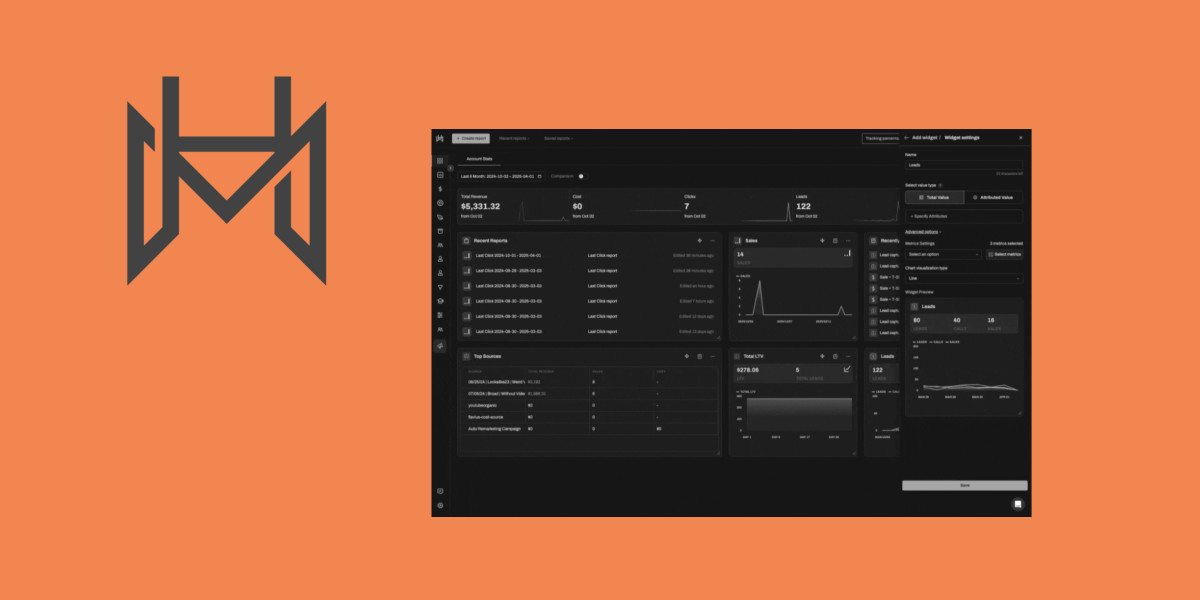
GrowthOptix connects marketing attribution directly to subscription revenue. You see which campaign brought a customer, what plan they subscribed to, whether they upgraded or churned, and what their actual LTV turned out to be — all in one revenue analytics dashboard. Hyros tracks ad performance to a conversion event, then stops. GrowthOptix keeps going through months and years of recurring revenue.
The platform has three core layers that work together:
The Blend unifies multiple Stripe and PayPal accounts into a single real-time view. Stripe syncs every 30 minutes with full historical backfilling. PayPal syncs every 4 hours with up to 3 years of history. One customer database across all processors.
Marketing Attribution tracks the full journey from first click through recurring subscription revenue using cookieless, cross-device tracking (GDPR/CCPA compliant). It maps every campaign to actual revenue outcomes using multiple attribution models — MRR, LTV, expansion revenue, and churn by acquisition channel.
Fai (Financial AI Agent) is a proprietary AI built only on your data. Ask "which campaign generated the highest LTV customers last quarter?" and get tables, charts, and recommendations. Save any prompt to your dashboard for automatic daily analysis. It can also create SmartLists — dynamic live segments like "all users who paid over $1K and signed up from TikTok."
What you get:
14-day free trial, no credit card required. Fai included on every plan (80 prompts/month on Starter, unlimited on Growth+). Concierge onboarding on Growth and above. Enterprise gets a dedicated CSM with SLA guarantees.
The downside? GrowthOptix evolved from Radix (which served 2,000+ SaaS companies since 2020), but the GrowthOptix rebrand launched in 2025 — still building its track record under the new name. Built for subscription businesses, so pure one-time-purchase ecom won't get full value. Stripe syncs every 30 minutes and PayPal every 4 hours (not sub-minute real-time). Ad platform historical import limited to 6 months.
Choose GrowthOptix if: You process payments through Stripe, PayPal, or both. You want to see which ads drive customers who stay and pay — not just clicks. You need MRR, churn, and LTV alongside attribution in the same tool.
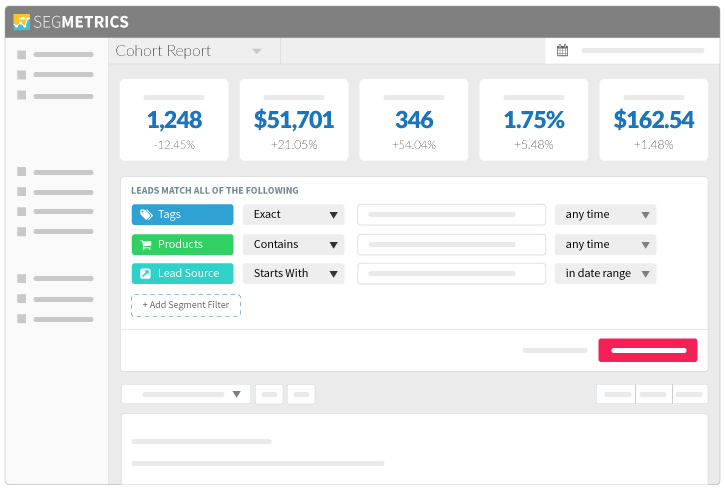
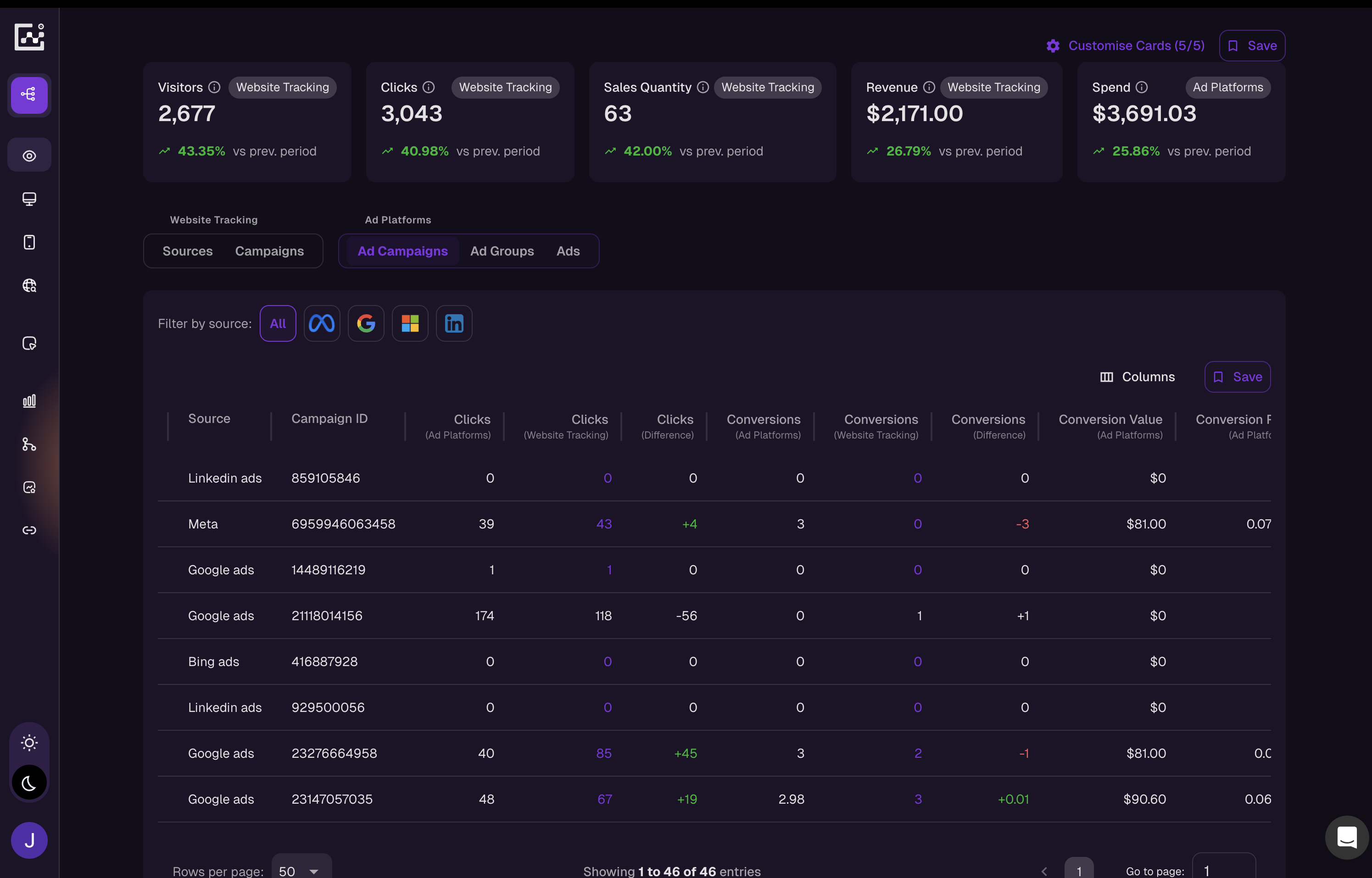
SegMetrics is the closest direct Hyros alternative for info-product businesses — at a fraction of the price. Built for businesses where customers consume free content for weeks before purchasing, then make multiple purchases over time.
Its deep Keap and Infusionsoft integrations are unmatched. It tracks not just the initial conversion, but every subsequent purchase, upsell, and renewal back to the original lead source — showing which traffic sources bring the highest LTV customers after 3, 6, and 12 months.
What you get:
Pricing (verified from segmetrics.io/pricing): Plans start at around $57/mo for the entry tier and scale up through Launch, Grow, Scale, and Enterprise based on active contacts in your ESP. The Scale plan runs around $397/mo. All plans include a 14-day free trial and unlimited users. Annual billing saves two months.
The downside? No public API. Setup has a learning curve — users frequently cite the breadth of features as overwhelming initially. Some users have reported billing issues including continued charges after cancellation. The interface feels dated compared to newer tools. And while the Keap/Infusionsoft integration is best-in-class, integrations with newer platforms can lag.
Choose SegMetrics if: You run an info product business, course, coaching program, or membership site. You use Keap or Infusionsoft as your CRM. Email nurture sequences are central to your sales motion. You need lifetime attribution tied to original lead source, not just first-purchase tracking. You want a Hyros alternative at a fraction of the price.
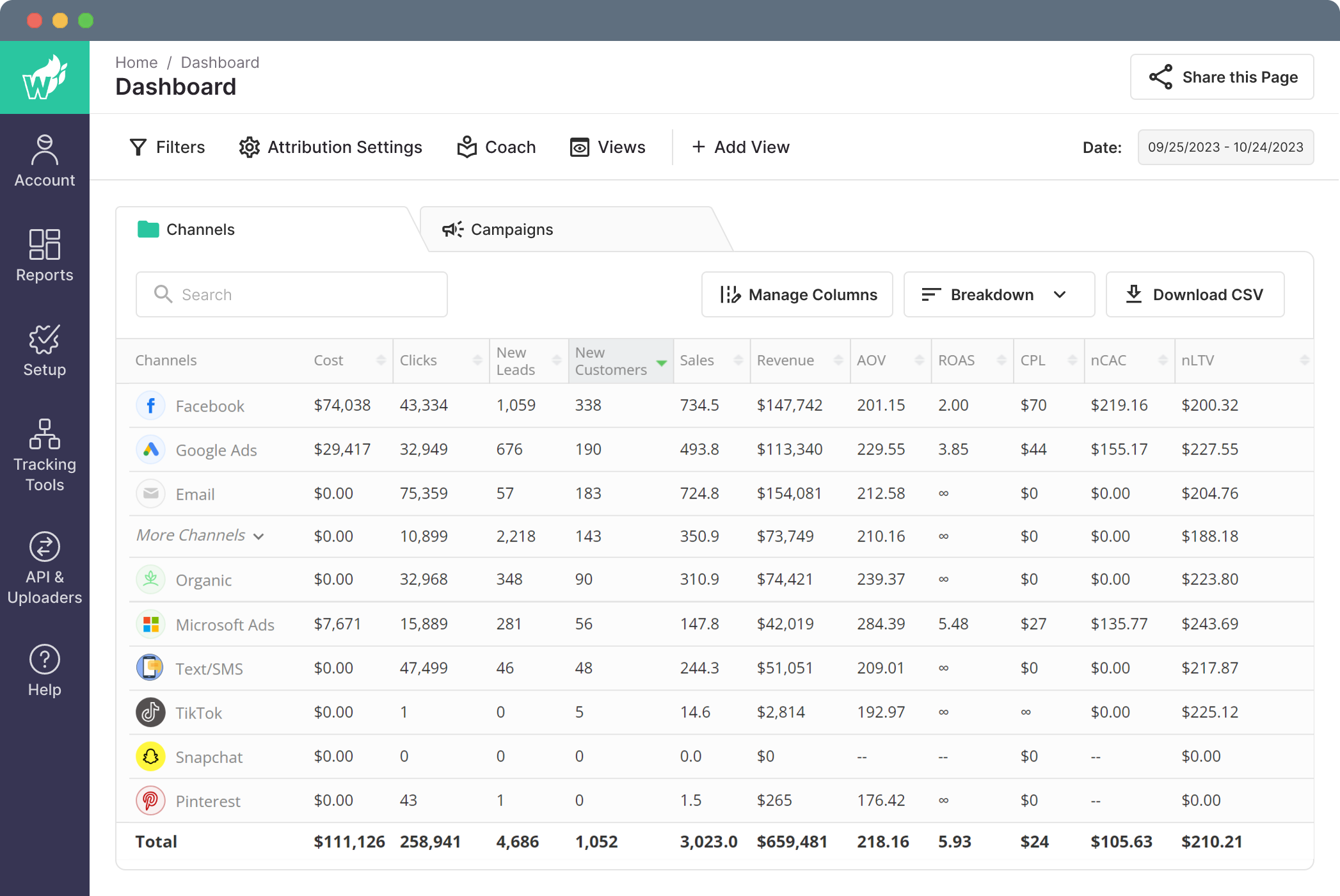
Wicked Reports solves a problem most attribution tools ignore: telling you which ads bring new customers versus which ones recapture existing buyers. For subscription DTC brands running heavy email/SMS through Klaviyo, that distinction alone can justify the cost.
It combines cookieless server-side tracking with infinite-window LTV attribution at a transparent published price. The 5 Forces AI delivers nightly Scale/Chill/Kill recommendations, and Advanced Signal feeds clean first-party conversion data back to Meta CAPI.
What you get:
Add-ons for Measure and Scale: Advanced Signal $199/mo, 5 Forces AI $199/mo. Annual pre-pay saves up to 2 months.
The downside? Pricing is tied to your revenue band, so you upgrade automatically as you grow. There's no free trial — only a demo. Setup has a learning curve, and the interface feels dated even after recent updates. Data processing can occasionally lag during high-volume periods.
Choose Wicked Reports if: You're an ecommerce or subscription brand doing $500K–$50M in annual revenue. You use Klaviyo or other email/SMS tools heavily. You need to separate new customer acquisition from existing customer recapture. You're moving away from Hyros and want similar long-window LTV attribution at a transparent price.
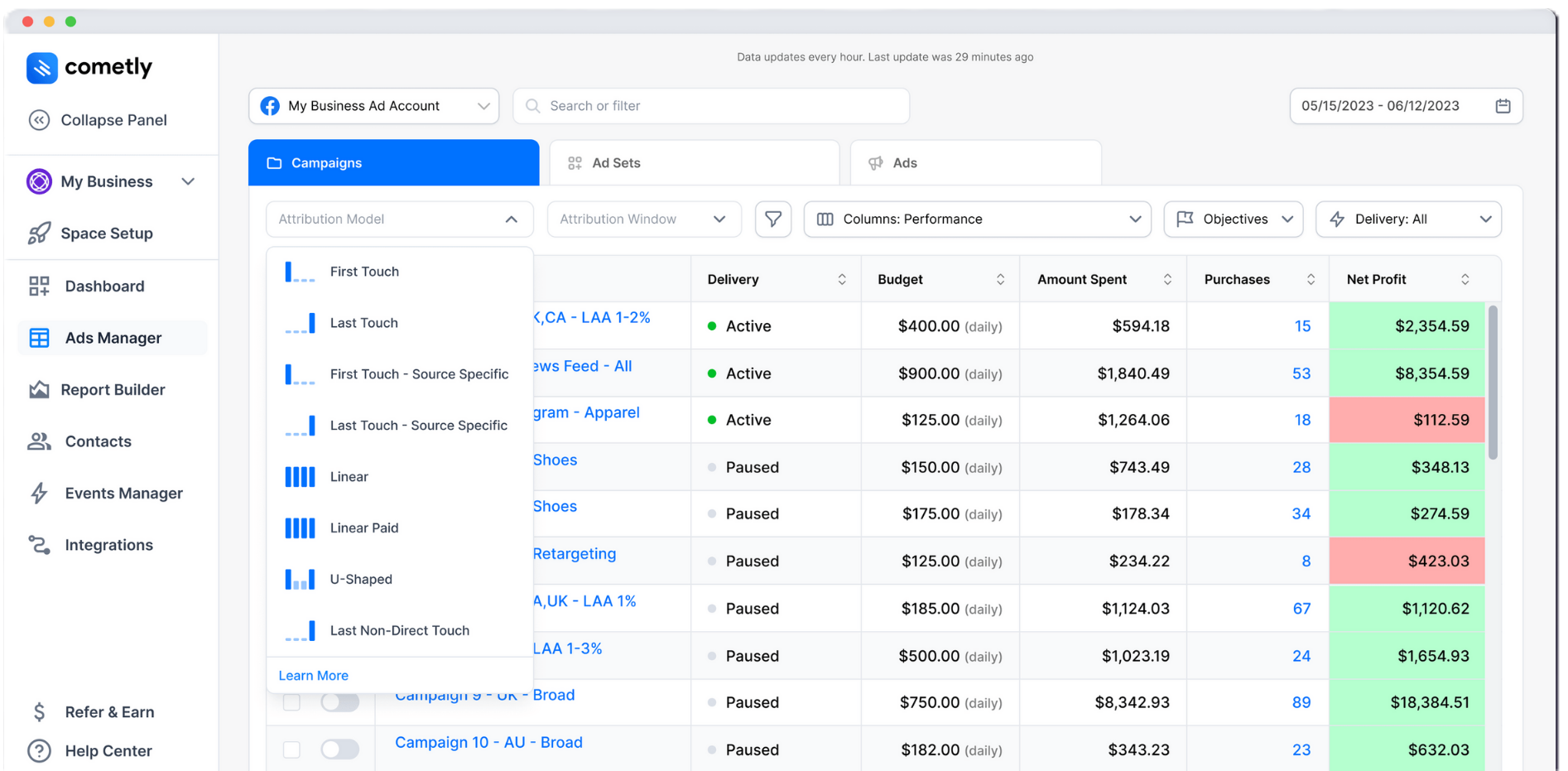
Cometly's core strength is its server-side Conversion API sync. It pushes verified conversion data back into Facebook CAPI and Google offline events in real time — when ad platforms get better data, their algorithms optimize better.
It also includes an AI Ads Manager for controlling budgets directly within Cometly, plus client workspaces for agencies managing multiple accounts.
What you get:
Pricing: Cometly does not publish pricing on its site — all plans are quote-based and tied to your ad spend volume. Third-party sources estimate Professional plans in the $200–$1,000/month range and Enterprise at $2,500+/month, but these are unofficial and may be outdated. A 14-day free trial is available on the current site; a sales call is required for a quote.
The downside? The lack of public pricing creates friction in the evaluation process. Setup can be time-consuming if you have a complex tech stack — this is a common user complaint. Documentation could be better. Some users have reported difficulty canceling subscriptions.
Choose Cometly if: You spend $20K+/month on paid ads and want to improve platform algorithm optimization. You value server-side conversion sync over simple reporting. You're an agency needing client workspace separation. You want a more affordable, user-friendly alternative to Hyros.
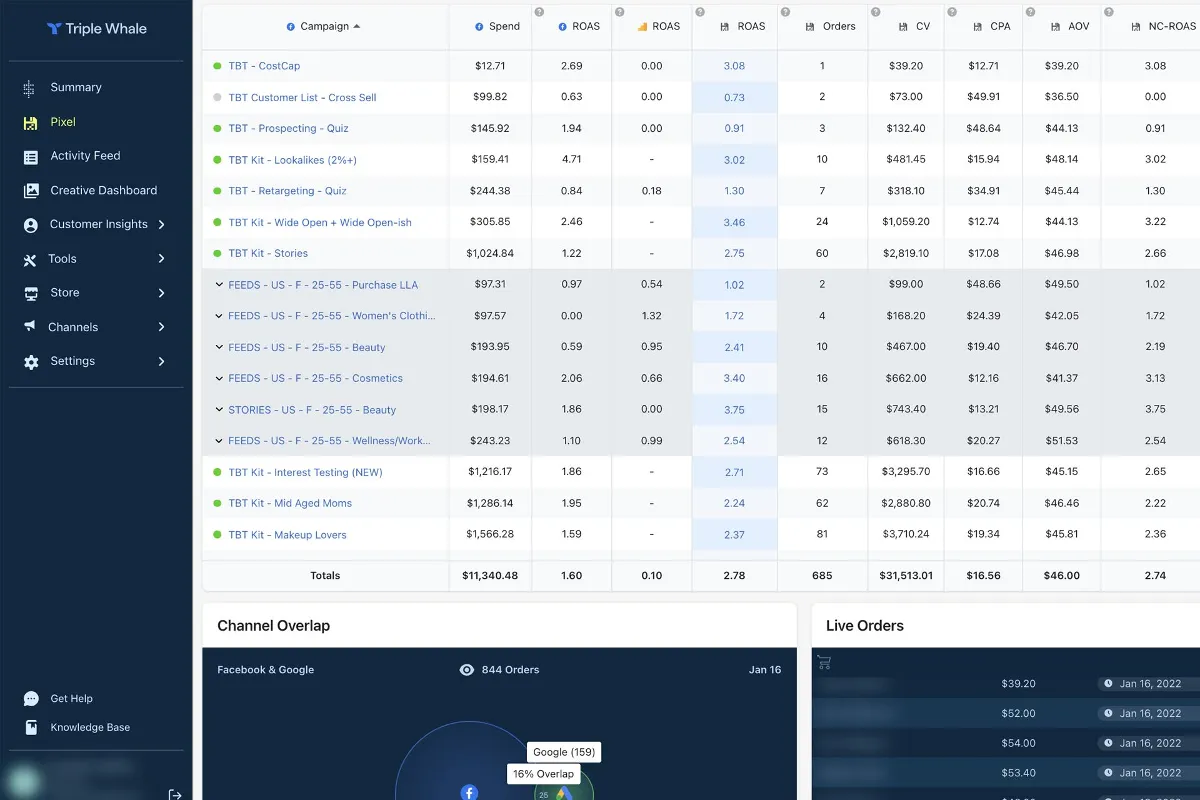
Triple Whale is the dominant player in Shopify attribution, used by 30,000+ brands. The free Founders Dash gives you a basic Shopify and ad platform dashboard at no cost. Paid tiers add the Triple Pixel, Sonar Send for email/SMS enrichment, and Moby AI agents for reports, forecasts, and ad creation.
The mobile app is exceptional — push notifications for revenue milestones, daily P&L, and real-time stats on the go.
What you get:
Pricing scales with a GMV slider starting at $250K. The $179 and $259 above are for the lowest tier. Annual billing gets two months free. Paid plans require a 12-month commitment.
The downside? Triple Whale has been primarily Shopify-only — if you're on WooCommerce, Magento, or a custom platform, it's historically not been an option (though they're beginning to expand). GMV-based pricing means your bill grows as your revenue grows, which can feel like a penalty for success. User reviews from 2025–2026 flag declining customer support quality, with some $600+/month subscribers reporting unresolved issues for months. Some users also report attribution accuracy being inconsistent on certain channels.
Choose Triple Whale if: You run a Shopify store doing $1M–$40M in annual revenue. You spend $10K+/month on paid ads across Meta, Google, and TikTok. You want a mobile app for daily performance monitoring. You value creative analytics and AI-powered recommendations.
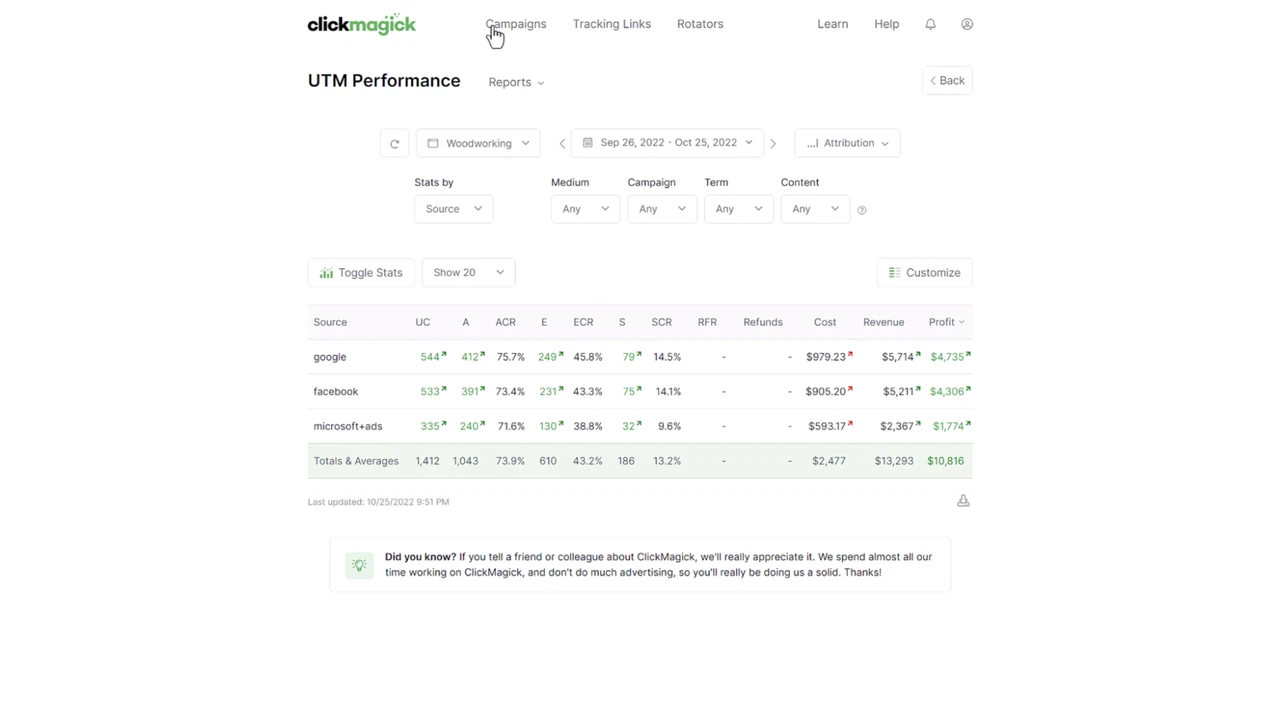
ClickMagick has been a staple in performance marketing since 2014. TrueTracking uses first-party scripts and custom tracking domains to evade ad blockers and iOS restrictions. Click Shield removes the vast majority of fake traffic. ClickMagick Insights surfaces meaningful performance shifts before you'd catch them manually.
At $79/month with a 14-day free trial and no sales call, it's the most accessible alternative to Hyros on this list.
What you get:
The downside? The interface feels dated compared to modern competitors. The Starter plan's 10,000-click limit gets exhausted fast if you're running meaningful ad volume. If you exceed your plan's click limit by more than 10%, you're automatically upgraded to the next tier, which can result in surprise billing. And at scale (1M+ visitors), you'd need multiple Pro accounts.
Choose ClickMagick if: You're an affiliate marketer using postback URLs and S2S tracking. You run funnel-based campaigns (webinars, VSLs, lead magnets). You want strong bot filtering to protect your ad spend. You need a more affordable, self-serve alternative to Hyros.
HockeyStack plays in a different category than Hyros. It builds complete B2B buyer journeys — from first anonymous website visit through every content download, webinar, sales call, and product demo to closed-won deal and expansion. Backed by $22.7M from Bessemer and Y Combinator.
Multi-touch attribution supports 8+ models including predictive. Lift analysis and marketing mix modeling measure incremental impact beyond basic attribution. Cookieless tracking means no consent banner issues in EU markets.
What you get:
Pricing: Custom quotes only — no pricing published on the site. Third-party sources estimate the core Platform plan starts around $2,200/month, with additional add-ons for account intelligence, sales intelligence, and data warehouse sync priced separately. Multi-year commitments can reduce costs by 20–50%. Startup pricing is available.
The downside? At an estimated $2,200+/month, HockeyStack is expensive — and that's just the starting point. The learning curve is steep, with users frequently mentioning significant time needed to understand all capabilities. The attribution logic can feel opaque — underlying rules aren't always transparent, and numbers don't always reconcile with your CRM. Some users report that onboarding quality varies depending on which internal team member you're assigned. There's no mobile app.
Choose HockeyStack if: You're a B2B SaaS company with $50K+/month marketing budgets. You use Salesforce or HubSpot and need marketing-to-pipeline attribution. You have marketing ops resources to manage the platform. You need account-based attribution, not just user-level tracking.
Dreamdata is HockeyStack's biggest competitor and the closest thing to a B2B "freemium" attribution platform. The free plan is genuinely useful — B2B web analytics, company identification (up to 80% of visiting companies), engagement scoring, and ad spend reporting.
It unifies CRM, MAP, ad platforms, and intent data into one account-based customer journey, then layers multi-touch attribution and AI-powered audiences on top.
What you get:
Contract terms and pricing require a demo conversation. Third-party sources estimate paid plans typically run $750+/month, with mid-market deployments in the $25K–$45K/year range, but Dreamdata does not publish these figures.
The downside? Paid plan pricing is fully opaque until you talk to sales. Setup takes 2–8 weeks before useful attribution data appears. Annual contracts are standard on paid plans. Lower-tier plans restrict user seats. Rule-based attribution models can feel inflexible compared to ML-powered alternatives.
Choose Dreamdata if: You're a B2B SaaS company looking for a strong free tier to start. You use Salesforce or HubSpot and need account-based attribution. You're considering HockeyStack but want a Europe-headquartered alternative. You can commit to annual billing.
RedTrack's core edge over Hyros is automation. Set rules to automatically pause campaigns when CTR drops, scale budget when ROAS exceeds a target, or route traffic to the best-performing offers — all without manual intervention.
The free Relay plan includes core tracking and CAPI for Meta, TikTok, and Snapchat — a real no-cost entry point for ecommerce stores.
What you get:
14-day free trial, no credit card required. Annual billing saves 2 months.
The downside? The initial setup is technical — several users hired professionals to handle migration and configuration of funnels, postbacks, and integrations. The learning curve is real for less experienced users. The free Relay plan is limited to 1 store, 1 user, and single currency. And while pricing remains competitive, it has increased over time from earlier tiers.
Choose RedTrack if: You're an affiliate marketer or media buyer managing campaigns across multiple networks. You want automation rules to manage campaigns without constant manual oversight. You need a free ecommerce tracking solution with CAPI support. You run an agency that needs white-label reporting and multi-client management.
WeTracked does one thing and does it well: it captures the conversion data that native pixels miss and pushes it directly back to your ad managers. Its 360° Data Enrichment Engine enhances raw store data beyond what basic Conversion APIs send, and the no-code setup connects to your store in under 2 minutes. No UTM parameters needed. No developer needed.
At $49/month with a 14-day free trial and 60-day money-back guarantee, it's the lowest-risk option on this list.
What you get:
14-day free trial + 60-day money-back guarantee on all plans.
The downside? WeTracked only supports last-click attribution — no multi-touch models, no first-click, no linear or time-decay. If you need to understand the full customer journey across multiple touchpoints, this isn't the tool. There's no LTV analysis, no cohort tracking, no creative analytics, and no API for custom integrations. The dashboard is functional but basic. And it's ecommerce-only — SaaS and B2B companies should look elsewhere.
Choose WeTracked if: You run a Shopify or WooCommerce store and your ad tracking is broken. You want the simplest possible fix with no technical setup. Accurate last-click attribution is good enough for your needs. You're on a tight budget and need to start at $49/month.
Northbeam combines multi-touch attribution, media mix modeling (MMM+), incrementality testing, and creative analytics in one platform. Its proprietary Clicks + Deterministic Views model provides more accurate view-through attribution than probabilistic approaches.
Northbeam Apex feeds first-party attribution data back into ad platform algorithms.
What you get:
Pricing: Northbeam describes four tiers publicly (Starter MTA, Professional MTA, Enterprise MTA, Enterprise + MMM) but publishes no dollar figures on its pricing page. Third-party estimates put Starter at roughly $1,000–$1,500/month and Professional at ~$2,500/month — but these may be outdated as pricing appears to have increased recently. Starter is month-to-month; Professional requires quarterly or annual commitment. No free trial available.
The downside? Northbeam is built for large budgets. If you're spending less than $250K/month on ads, you probably won't get enough value to justify the cost. Onboarding has drawn complaints — users describe weeks of back-and-forth during setup. Recent user feedback flags that Northbeam stripped hands-on support from clients paying under $1K/month. The reporting provides insights but doesn't automate budget rebalancing — you still need to act on the recommendations manually.
Choose Northbeam if: You spend $250K+/month on paid media across 5+ channels. You need media mix modeling and incrementality testing, not just click attribution. You have a dedicated analyst or marketing ops team to leverage the data. You're advertising on hard-to-track channels (podcasts, CTV, influencer).
AttributionApp hits a sweet spot that most platforms on this list miss: genuine multi-touch attribution with CRM integration at a price that doesn't require CFO approval. The Shopify Starter plan at $19/month is the most affordable MTA solution available anywhere. The B2B Pro plan at $399/month connects to Salesforce, HubSpot, and Segment with account-based attribution — a fraction of what HockeyStack charges for similar capabilities.
One unusual strength: AttributionApp tracks offline channels (radio, TV, OTT, podcasts, direct mail) alongside digital, which is rare at this price point. Cohort-based reporting shows ROAS by channel by time period and tracks payback periods — particularly valuable for businesses with longer sales cycles.
What you get:
7-day free trial (Shopify) or 14-day free trial (B2B plans).
The downside? Attribution sophistication is basic compared to ML-powered tools like Northbeam — no media mix modeling, no incrementality testing, no predictive analytics. There's no view-through attribution, no API for custom integrations, and limited data visualization options. It can also be slow when processing large data volumes. The user base is smaller, which means fewer community resources and peer benchmarks.
Choose AttributionApp if: You need multi-touch attribution at $19–$399/month instead of $1,000+. You're a B2B SaaS company using HubSpot or Salesforce. You want offline channel tracking alongside digital. You've outgrown Google Analytics but aren't ready for enterprise pricing.
Usermaven takes a fundamentally different approach than Hyros. Instead of focusing narrowly on ad attribution, it combines website analytics, product analytics, and multi-touch attribution in one privacy-first platform. The cookieless tracking works without consent banners, the ad-blocker bypass via custom subdomain captures significantly more data than client-side tools, and EU-hosted data storage keeps compliance teams happy.
Maven AI lets you ask questions about your analytics data in natural language — similar to GrowthOptix's Fai but focused on web and product analytics rather than revenue metrics. The white-label option at $49/month makes it practical for agencies managing multiple client dashboards.
What you get:
The downside? Attribution features are only available on the Scale plan ($199+/month) — the Growth plan doesn't include them. There are no session replays, heatmaps, or qualitative analytics. Native integrations are limited compared to Mixpanel or Amplitude. There's no mobile app analytics support. And the attribution modeling is basic compared to dedicated attribution tools — no media mix modeling, no incrementality testing, no view-through attribution. If deep ad attribution is your primary need, Usermaven won't replace Hyros or most other tools on this list.
Choose Usermaven if: Privacy compliance is a hard requirement (GDPR, CCPA, EU data hosting). You want website analytics + product analytics + basic attribution in one tool. You're replacing Google Analytics and want something simpler. You're an agency that needs white-label, multi-workspace analytics.
DV Rockerbox (acquired by DoubleVerify in a deal announced February 26, 2025 and closed March 13, 2025 for a net $82.3M per DV's SEC filings) is the enterprise-grade option for brands running marketing across both digital and traditional channels. It combines multi-touch attribution, marketing mix modeling, and incrementality testing into one platform — and unlike most competitors on this list, it can actually attribute TV spots, CTV, podcast sponsorships, direct mail, and retail media alongside digital ads.
The unified, SOC2-certified data foundation centralizes data from 100+ channels. You can start with whichever methodology fits today (MTA, MMM, or incrementality) and add the others as your measurement questions evolve.
What you get:
Pricing (custom quotes only — not published): Per third-party data, plans typically start around $25,000/year for smaller deployments and scale to $60,000–$70,000/year for typical clients. Advanced configurations can exceed $100,000/year. Mid-market and enterprise deployments often reach mid-six figures.
The downside? Enterprise pricing means it's not accessible for smaller brands. Setup and onboarding require significant time investment. Some users describe the "bucket" terminology as confusing initially. Following the DoubleVerify acquisition, the roadmap may shift toward verification and brand safety use cases. No free trial.
Choose DV Rockerbox if: You're a mid-market or enterprise brand spending heavily on both digital and traditional/offline media. You need TV, podcast, CTV, or direct mail attribution alongside digital ads. You have budget for $25K+/year and dedicated marketing ops resources. You want incrementality testing and MMM in the same platform as MTA.
(See the full feature comparison table in the markdown version — too wide for Word format.)
Start with three questions. They'll narrow the field immediately.
What's your business model? SaaS/subscription → GrowthOptix. Info products/courses → SegMetrics. Shopify ecom → Triple Whale or WeTracked. Subscription DTC on Klaviyo → Wicked Reports. B2B with complex sales cycles → HockeyStack, Dreamdata, or AttributionApp. Affiliate/media buyer → ClickMagick or RedTrack. TV/podcast/direct mail → DV Rockerbox.
What's your budget? Under $100/mo: WeTracked ($49), AttributionApp ($19), SegMetrics ($57+), Usermaven ($84 or free), GrowthOptix ($99). $100–$500: Wicked Reports, ClickMagick, RedTrack, Cometly. $1,000+: Northbeam, HockeyStack, Dreamdata. $25K+/yr: DV Rockerbox.
What do you actually need? Broken tracking → WeTracked (2-minute fix). Attribution tied to subscription revenue → GrowthOptix. Lifetime attribution by lead source → SegMetrics. MMM and incrementality at scale → Northbeam or DV Rockerbox. Privacy compliance → Usermaven.
Hyros is the wrong default for most businesses in 2026. Pricing starts at $230/month billed annually and scales up from there, with a mandatory sales call and no free trial (just a 90-day money-back guarantee). If you're not selling high-ticket info products through phone-close funnels, you're paying for tooling built around someone else's business model.
Here's the shortcut:
The reason GrowthOptix sits at #1 isn't that it beats every tool at every job — it doesn't. It's that for the largest underserved segment in this list (subscription businesses paying for attribution and revenue analytics separately), it replaces two tools with one, at a price below what most people pay for either alone. If you're also evaluating subscription analytics platforms specifically, see our comparisons of ChartMogul alternatives and Baremetrics alternatives. If Hyros alternatives is what brought you here, the trial costs you nothing and the answer takes a week.
Join hundreds of SaaS companies who finally understand which marketing drives profitable growth.